
Two of them are in the United States. And one has a 90-foot indoor rainforest.
Most airports are places people endure, not admire. But a handful of new terminals around the world are genuinely changing that, and an elite international competition has just named the seven most architecturally extraordinary ones on the planet for 2026.
The Prix Versailles is not a small-scale industry award. It is an annual international architectural competition that announces its results at UNESCO headquarters in Paris, and it covers everything from stadiums and museums to train stations and hotels.
The airport category is among its most watched. Judges weigh a terminal’s layout and passenger flow, how well it integrates with its natural surroundings, and whether it makes meaningful use of local materials and cultural design traditions.
For 2026, the Prix Versailles named seven new airport terminals across five countries as the most beautiful in the world. Two of them are in the United States.
The timing is notable. Approximately $14.5 billion in federal grants has been earmarked for major U.S. airport infrastructure projects, and the results are starting to show.
Here is every terminal that made the list, and what makes each one worth knowing about.
Frankfurt Airport Terminal 3, Germany
For Frankfurt’s new Terminal 3, which officially opened in April, architect Christoph Mäckler worked from the premise that airports draw more visitors than most urban centers. That thinking shaped everything.
He designed piers, gates, and lounges to emulate city streets and squares, with an eye toward passenger flow and efficiency. Floor-to-ceiling glass bathes most of the terminal in natural light, keeping artificial lighting minimal.
The visual anchor of the space is hard to miss. Three suspended rings of colored aluminum rotate above the main square of the terminal. It is the kind of detail that makes layovers feel less like a sentence.
Guangzhou Baiyun International Airport Terminal 3, China
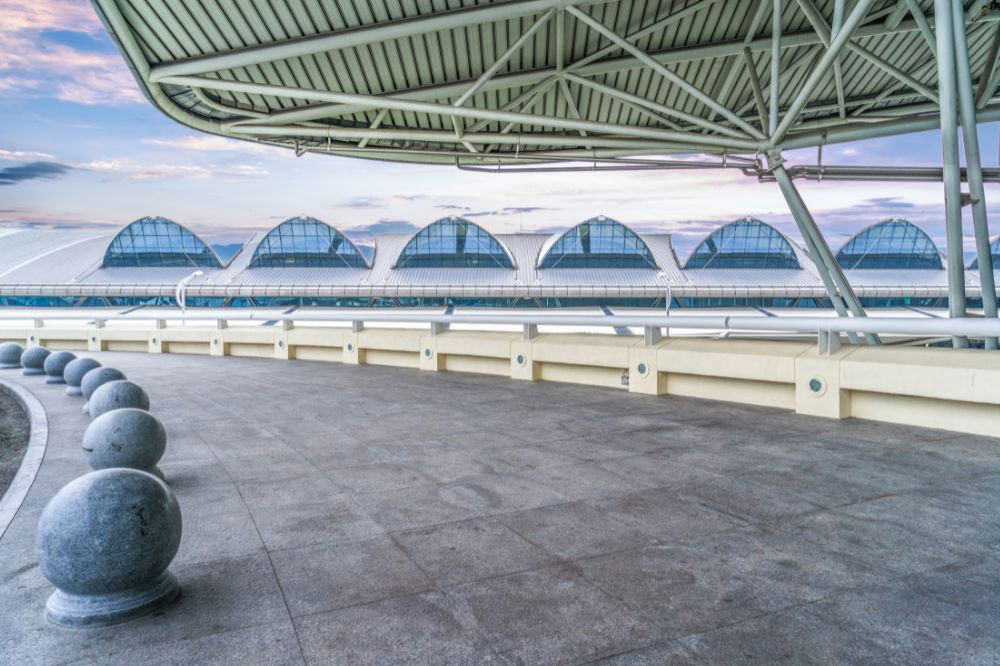
Guangzhou has been called the “City of Flowers” for centuries, and the airport’s newest terminal takes that literally. Architects drew on natural elements including clouds, water, and flowers, showcased in a central atrium and a series of terraces and gardens.
Passengers can also experience an eighth-floor open-air public observation deck, the highest at an airport in China.
The interior design, with organic curves and a sense of movement, is said to evoke the Maritime Silk Road. Terminal 3 opened in October 2025, alongside a fifth runway.
Pittsburgh International Airport, Pennsylvania
For the new PIT terminal, designers took their cue from the forest-shrouded Allegheny Mountains, with a swooping timber roofline held up by 38 steel columns shaped like trees.
The canopy sits above glass walls that flood the space with natural light, and four terraces will soon give travelers access to fresh air before their flights.
A nod to the city itself runs through the whole design. An old underground train to the gates is gone, replaced by the Petal Tunnel, mimicking the drive into Pittsburgh through the Fort Pitt Tunnel. The more compact layout also means shorter walking distances and better energy efficiency.
Techo International Airport, Phnom Penh, Cambodia
Foster and Partners designed this $2 billion terminal to run almost solely on solar power, featuring a modular roof that echoes Cambodia’s grand palaces and temples. There is even an on-site solar farm.
Inside, the design gets more intricate. The ceilings appear as if they are woven from bamboo and rattan, a nod to traditional basket weaving. These canopies cut the need for mechanical ventilation and daytime lighting.
Rumduol trees, the national flower, grow throughout the central atrium, and an abundance of greenery follows passengers through the terminal. Walking distances are short across the single canopy roof, from the drop-off curb to the gate.
Mumbai spent roughly two decades planning and building its newest airport, a monumental effort that included reclaiming land from the sea.
The lotus-like design from Zaha Hadid Architects features a roof unfolding in petal-shaped shells from a central atrium. It is functional as well as striking. The shape handles monsoon runoff and strong winds. The airport’s first commercial flight took off in December 2025.
San Diego International Airport Terminal 1, California
The $3.8 billion terminal, which opened in September 2025, replaces a 1967 building that was designed for 2.5 million passengers a year. By the end it was moving more than 12 million.
The new terminal reflects how Southern Californians actually live. There is a focus on natural light and outdoor space, including a 5,000-square-foot terrace overlooking the harbor and downtown.
The standout feature is the facade. An 800-foot piece of public art called Luminous Wave, built by glass artist James Carpenter, features 537 curved panels that shift from silvery gray by day to pinkish-orange at dusk and filter out heat and glare.
Lokapriya Gopinath Bardoloi International Airport Terminal 2, Guwahati, India
This one is arguably the most extraordinary terminal on the entire list.
GAU Terminal 2 sits in Assam, in northeast India, at the crossroads of South and Southeast Asia. Mumbai architect Nuru Karim designed it around the bamboo orchid, a symbol of the region’s biodiversity.
Inside, vaulted ceilings reference Assam’s sacred landscapes and indigenous building traditions. Indigenous art and tribal narratives are displayed in waiting areas that many airports leave blank.
Then there is the centerpiece. A Sky Forest, a 90-foot indoor rainforest with roughly 100,000 plants across 100 native species, anchors the terminal. Commercial flights started in February 2026.
It is a strong list for American travelers to pay attention to. Two U.S. airports made the cut, both of them recently opened and both representing a genuine shift in how the country thinks about airport design.
And for anyone with upcoming international travel, terminals in Cambodia, India, Germany, and China are now worth building a layover around.