
Millions of people do it every single flight without really knowing why. And what’s happening above 10,000 feet is a lot more complicated than anyone told you.
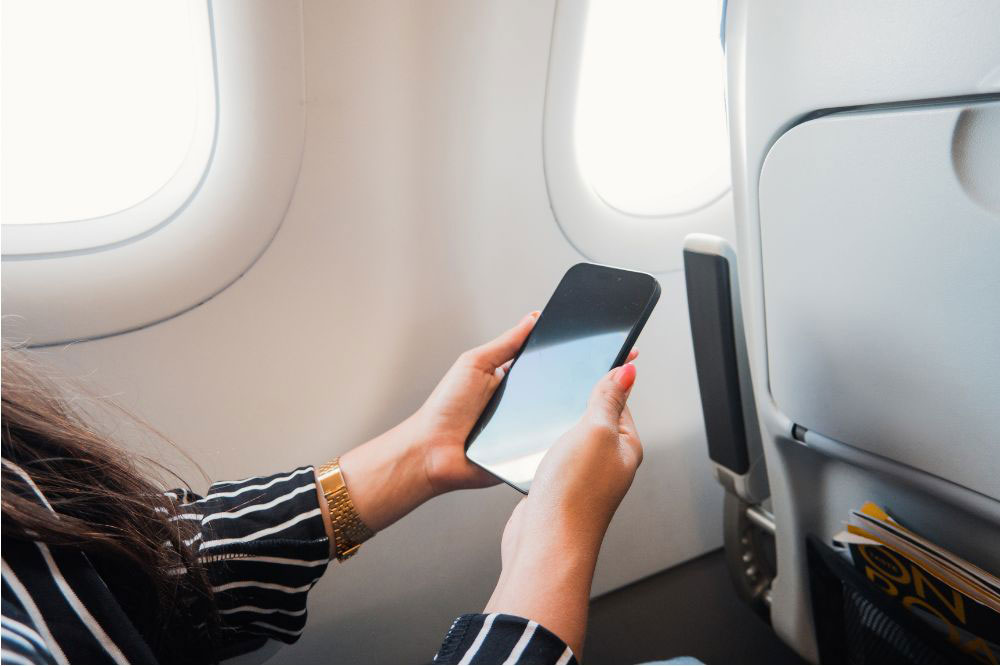
Every time a plane pushes back from the gate, the announcement comes. Phones to airplane mode. Tray tables up. And most passengers comply without question, swiping that little airplane icon and getting on with their movie.
But the rules around airplane mode are shifting fast, and depending on where in the world you’re flying, the regulations governing what your phone can and can’t do in the air are now very different from each other.
So what’s actually going on?
What airplane mode actually does
Turning on airplane mode cuts all wireless and cellular signals from the device. That means no calls, no texts, no cellular data.
The catch is that it doesn’t have to mean total disconnection. Once airplane mode is enabled, users can manually switch Wi-Fi and Bluetooth back on individually.
Many phones will even remember those preferences and restore them automatically each time airplane mode is activated.
There’s also an unexpected bonus for frequent travelers. Phones in airplane mode consume less power. Fewer active signals mean the battery drains more slowly, and charging speeds up slightly too. It’s a small win, but on a long-haul flight, it’s worth knowing.
Why the U.S. still requires it
In the United States, the rule comes from two separate federal agencies.
The FAA has long cited potential interference with onboard aircraft systems as the reason passengers must disable cellular signals. The FCC, meanwhile, has its own prohibition on using cell phones while airborne, written into the Code of Federal Regulations.
The specific system that’s caused the most debate is the radio altimeter. This instrument measures exactly how far an aircraft is from the ground, which makes it critical during landing.
For years, aviation authorities have been concerned that 5G signals could interfere with those readings.
In July 2026, the FAA issued a final rule requiring all radio altimeters operating in U.S. airspace to be upgraded to tolerate interference from 5G networks.
It ended a debate that had dragged on for years, though the underlying regulation requiring airplane mode during flights remains in place.
Can your phone even connect at altitude?
Technically, yes, at least at lower altitudes.
Sven Bilén, a professor of engineering design, electrical engineering, and aerospace engineering at Penn State University, has explained that if a plane is flying below roughly 10,000 feet, a phone might be able to latch onto a cell tower on the ground.
The connection would be unstable, bouncing between towers as the aircraft moves, and it could interfere with ground-based networks.
Above that altitude, a standard cellular signal is extremely unlikely to connect at all, unless the aircraft itself is equipped with its own onboard mobile service.
But whether or not a signal is technically possible, using one is still prohibited in the U.S. The Code of Federal Regulations is clear: all cellular phones on an airborne aircraft must be turned off.
A bipartisan group of members of Congress pushed that further in July 2026, introducing the Quiet Skies Act, a bill that would turn the current FCC regulation into a formal law banning in-flight calls entirely.
Why passengers in Europe can already use their phones freely
The gap between American and European rules on this comes down to both technology and regulatory structure.
The European Union mandated 5G availability on aircraft back in 2023. As a result, passengers flying within EU airspace don’t need to enable airplane mode at all. They can use cellular data mid-flight the same way they would on the ground.
The most significant development came in March 2026, when British Airways went even further. On aircraft equipped with Starlink, the high-speed satellite internet network, BA now permits passengers to make voice and video calls during flights.
It’s worth noting that several U.S. carriers, including United, Hawaiian, and WestJet, also have Starlink installed. Southwest and American are in the process of adding it.
But those airlines prohibit voice calls regardless, and if the Quiet Skies Act passes, that restriction would become federal law.
What happens if you skip airplane mode
Flight attendants cannot easily tell whether a passenger has enabled airplane mode or not. That practical reality means many people quietly skip it without consequence.
But the legal exposure is real. FCC and FAA regulations require passengers to follow all crew instructions regarding electronic devices. Violating those rules carries the potential for suspension of cellular service and financial fines.
The more immediate enforcement is social. Cabin crew can and do ask passengers to comply, and persistent refusal during a flight is not a situation anyone benefits from.
The bigger picture
Airplane mode is one of those travel habits that most people follow on instinct without ever questioning the reason behind it. The actual regulatory picture in 2026 is more nuanced than the onboard announcement suggests.
In the U.S., the rules remain strict and are potentially getting stricter. In Europe, passengers already have freedoms that American travelers don’t, and some airlines are now permitting in-flight voice calls with no restrictions at all.
The technology has moved faster than the regulation. And for anyone flying regularly, understanding what’s actually required versus what’s simply become habit is information worth having before the next boarding announcement plays.