
Discover the top Cornish hidden gems like a local with this guide. Here you will find the most stunning Cornwall beauty spots and off the beaten track places, details on how to get around, and where to stay in this unique Celtic nation.


Cornwall is one one of the most popular holiday destinations in the UK, however, there are still corners of this remote county that are not so well known.
From quaint fishing villages tucked away in pretty coves and beaches with breathtaking geological features, to prehistoric monuments that remind you of its intriguing Celtic heritage, Cornwall has plenty to offer for every type of traveller.


In this guide I will show you the top hidden gems in Cornwall, but before I do that, let me tell you how to discover it like a local.
Table of Contents
Where to stay to experience Cornwall like a local
One of the best ways to explore a destination is without a doubt by experiencing it as a local. But what does that actually mean?
For me, the choice of accommodation is an important aspect of getting to know a place from a local’s point of view. So with this in mind, I chose to stay in a traditional Cornish cottage with Classic Cottages.


The cottage that I chose was called The Hideaway and it was located in the heart of the fishing village of Mousehole, in the far west of Cornwall.
This quaint little cottage was once a Pilchard Press, where pilchards were literally pressed in order to extract oil to use as fuel for street lamps in the old days.


Tucked away in a tiny courtyard accessible through an impossibly narrow alleyway, this deceivingly spacious cottage has been sympathetically renovated with all the comfort and style of a modern cottage, but retaining original features that give you hints of its past.


Details such as the exposed stone walls, wooden beams and a pilchard theme throughout the house reminded me that I was staying in a village with a long fishing tradition.


Split over two levels, the cottage had two bedrooms and two bathrooms, with a generous kitchen and dining area. But my favourite room in The Hideaway was the living room, with its stone fireplace, the stable door and the high ceilings.
Classic Cottages has a lot of properties throughout Cornwall, as well as the rest of the UK, and it was super easy to book through them.


But let’s move on and explore the top hidden gems in Cornwall.
Mousehole
Mousehole is where I based myself while I explored Cornwall. It’s a quaint little fishing village with a lot of history and the most picturesques harbour.


The whole village, minus one house, was completely burnt to the ground by the Spaniards back in 1595. That house stands today and you can stay in it through Classic Cottages too.
A bustling fishing port one hundred years ago, today Mousehold retains a lot of the charm of the old days and it’s a joy to wander around its narrow streets soaking up its character and lovely atmosphere.
St Michael’s Mount
This one is not much of a hidden gem, but I had to include it as it’s a must visit for anyone wanting to explore Cornwall. St Michael’s Mount is one of the most iconic places to visit and must not be missed.
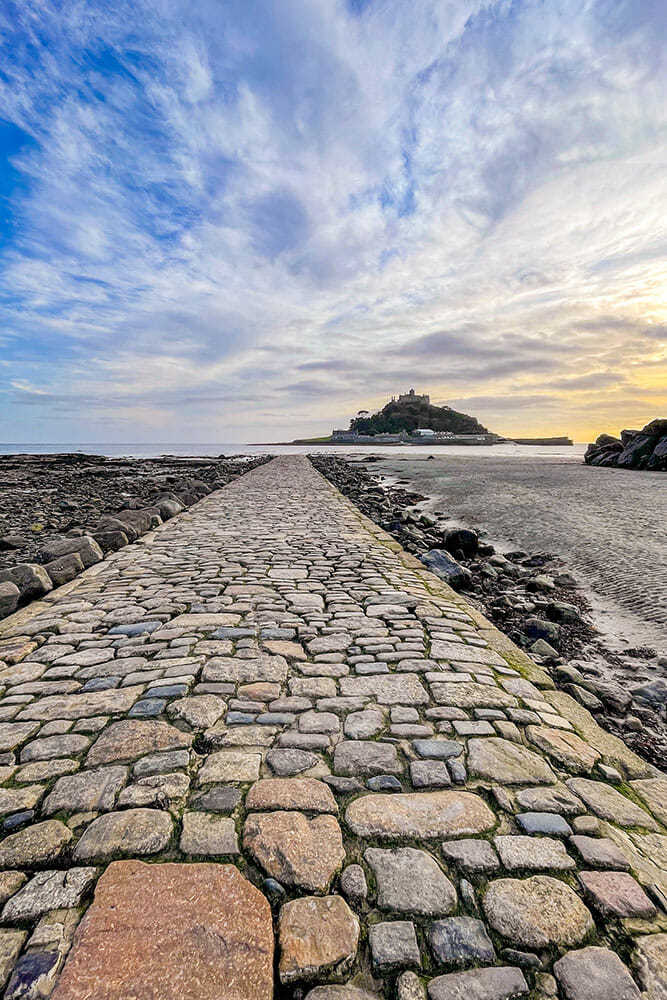

Located in the town of Marazion, St Michael’s Mount is a tidal island with a castle on top that is accessible at low tide by a man-made causeway. It will probably remind you of Mont-Saint-Michel in France. In fact, St Michael’s Mount was once the property of Mont-Saint-Michel after the Norman Conquest of 1066.
Today you can visit the castle, but only at low tide when the causeway is accessible. Make sure you check the tide times when planning your visit.
Minack Theatre
Making the most of a spectacular setting, the Minack Theater will take your breath away. An open air theatre built onto a rocky outcrop jutting out to the sea.


Built in the 1930s by Rowena Cade in her garden, it is currently used from Easter to September by theatre companies from the UK and the US.
If you visit Cornwall during the summer, seeing a play in this unique stage with the sea as backdrop is an absolute must. However, if there are no performances, you can still visit the theatre and the gardens all year round. You may even witness a rehearsal!
Nanjizal Beach
Cornwall’s coastline is extraordinarily beautiful, with its rocky cliffs, sandy beaches, and cute secret coves. This wild coast is what made smuggling so easy at the height of the 18th century. There were so many places to hide contraband, and to discover today!
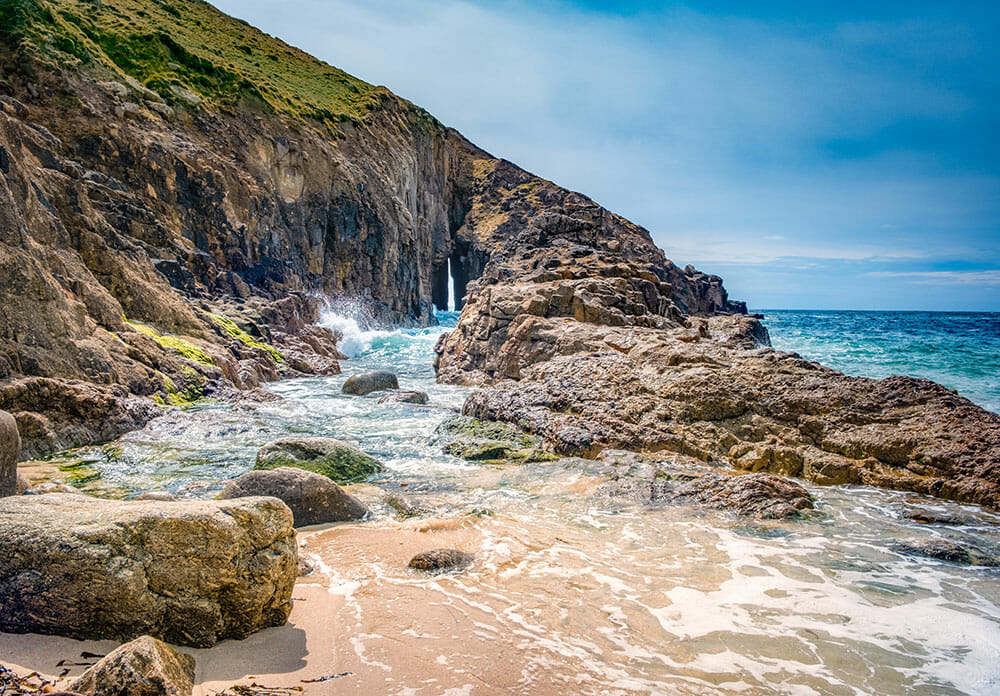
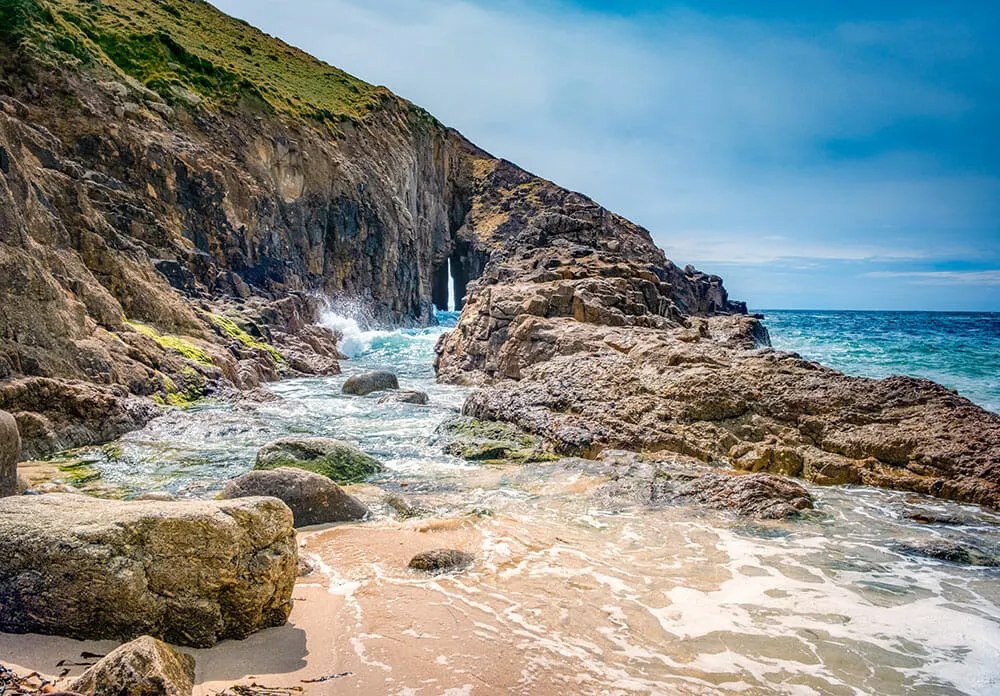
One of these places is Nanjizal Beach, a pretty cove with incredibly clear water . It’s not easily accessible, but if you make the effort to reach it you will be rewarded by plenty of hidden caves and rock formations.
But the most striking feature is the narrow natural arch over the water known as Song of the Sea.
Lanyon Quoit and other quoits
Cornwall is steeped in ancient history, and as you drive around the far west area you will spot megalithic monuments all around seemingly placed in the middle of fields.


These monuments are quoits, great megalithic chamber tombs found only in Penwith. They date back to around 3500 – 2500 BC and are among the oldest stone monuments in Cornwall. They were not burial sites, but rather places where ritual burial offerings were made.
Lanyon Quoit is possibly the best known and the most accessible. It can be found in a field along the Penzance-Madron-Morvah road. The light during sunset is magical.
Cadgwith
Cadgwith is a quintessential Cornish fishing village located in a coastal valley on the western side of The Lizard Peninsula.


With its traditional whitewashed thatched cottages, it feels like the village has been forgotten by the 21st century. But Cadgwith is alive and well, with a working fishing fleet winched up on the shingle beach that gives the village a splash of colour.
The whole valley oozes charm, enhanced by the delightful cottage names like ‘Dolphin Cottage’, ‘Kiddleywink’ and ‘Pink Cottage’.
If you have the chance to visit on a Friday evening, make sure you go to The Cadgwith Cove Inn, where you can enjoy the famous Cadgwith Singers and their sea shanties.
Kynance Cove
Yes, I know. Not really a Cornish hidden gem, but you can’t visit The Lizard Peninsula and not visit Kynance Cove, right? It is one of the most photographed spots in Cornwall, and with good reason.

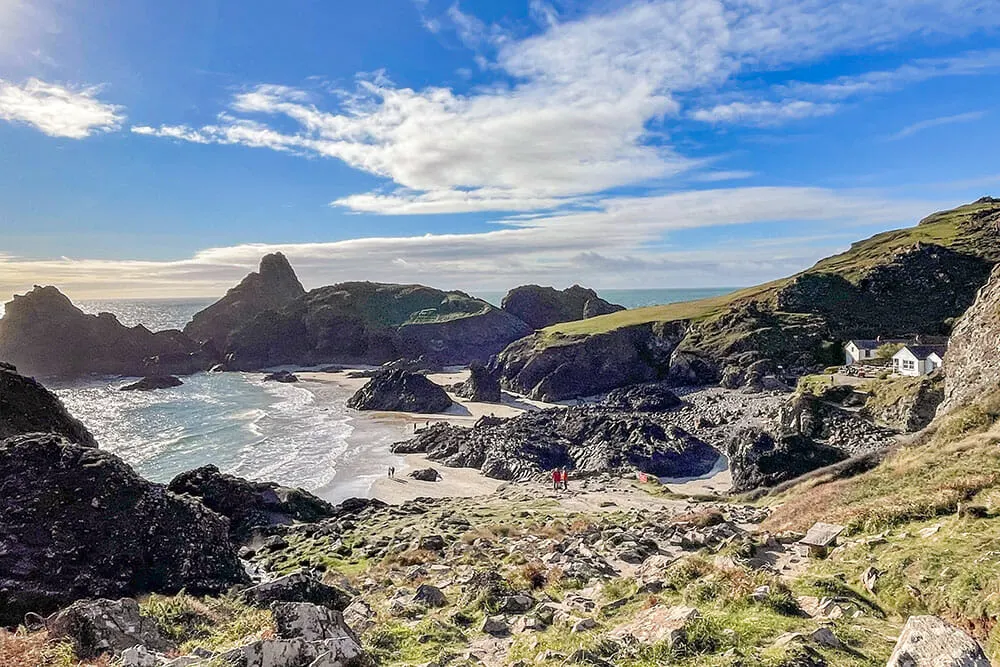
This tidal beach is famous for its white sand, its rocky stacks and turquoise waters that will make you think you’re somewhere in the Caribbean or the Mediterranean.
It’s a 15 minute walk down to the beach from the car park, but it’s really worth the effort. If you are visiting in the summer, try and arrive as early as possible as the car park fills up very quickly.
And if you are hiking in Cornwall, make sure you include a section that includes Kynance Cove. Arriving here by foot will be one of your highlights in this beautiful county.
Tintagel Castle
Located in Cornwall’s rugged north coast, Tintagel Castle is a place of myths and ancient history. Closely linked to the legend of King Arthur, this ancient settlement goes back to the 5th century.


Here you will feel the magic of timeless legends as you uncover the tales of King Arthur and the tragic love story of Tristan and Isolde.
Walk around the 12th century castle ruins, cross the breathtaking new bridge and take in the views of the spectacular coastline. And don’t forget to stroll along the sandy beach and visit Merlin’s Cave during low tide.
Boscastle
Not far from Tintagel Castle, Boscastle is one of the prettiest villages in Cornwall. Dating back to medieval times, it is hidden away in a steep valley and has a tiny little harbour that has hardly changed since Elizabethan times.


Visit the Forrabury Stitches, an ancient field system composed of long strips separated by unploughed ridges that dates back to Celtic times, and is still being farmed in a traditional way.
Boscastle also has a museum like no other – the Museum of Witchcraft and Magic. It’s open all year round, but during Halloween it celebrates an All Hallow’s Eve Gathering, making Boscastle a great place to celebrate Halloween.
St Nectans Glen Waterfall
Located in an Area of Outstanding Natural Beauty in Trevethy Woods, St Nectan’s Glen is a spectacular sixty foot waterfall carving its way through a hole in the rocks. It is one of Cornwall’s best kept secrets.


The waters are said to have healing powers and the place is shrouded in myths and legends – from fairy and piskies (pixies) sightings to King Arthur.
You will likely see fairy stacks of stones around, which many people create in memory of loved ones who have passed. There are also logs and benches covered with coins inserted by people making wishes.
Restormel Castle
High above the valley of the river Fowey, you will find the ruins of the keep of an ancient castle that once belonged to Edward, the Black Prince, son of King Edward III.


This Cornish hidden gem dates back to the 13th century, although there has been a castle here since the 11th century. Today the remains of the keep give us a clue of how grand and luxurious this castle once was, with its large fireplaces, high windows and the Great Hall.
Climb to the top of the stone staircase in the courtyard for stunning views of the countryside.
Charlestown Harbour
Charlestown Harbour is a great example of a late Georgian working port. It’s the last open 18th century harbour in the UK and it’s a UNESCO World Heritage Site.


Once built to export copper and china clay, it is now a popular filming location for productions such as Poldark and Mansfield Park.
The harbour is home to a number of historic vessels, and with its surrounding Georgian homes, it makes you feel like you’ve been transported to a bygone era.
Gwennap Pit
Less than a mile from Redruth, you will find an unusual geographical and historical spot called Gwennap Pit. It is a depression in the ground possibly caused by mining activities that was carved into an amphitheatre.


It was here where John Wesley, the founder of the Methodist Church, preached in the 18th century. He referred to the Pit as ‘the most magnificent spectacle this side of heaven’.
Gwennap Pit has 12 circular terraces and can hold around 1,500 people.
Psssst… If you are exploring the South West of England, here are some great ideas for days out in Devon too.
Getting around Cornwall
Cornwall is a pretty remote rural county. Despite this, a lot of the towns, both coastal and inland, are linked by trains and buses.
However, if you really want to explore Cornwall off the beaten track and discover as many Cornish hidden gems as possible, and not be restricted by public transport schedules, you will need your own car to get around.
If you don’t have your own car, I would recommend hiring one. You can find really good deals on car hire comparison sites like Travel Supermarket or Auto Europe.
Find the best car hire deals with Travel Supermarket
Find the best car hire deals with Auto Europe
Have you been to any of these hidden gems in Cornwall? Would you add any others?
Let me know in the comments!
LIKE THIS POST? PIN AND SAVE FOR LATER


Disclosure: This post has been created as a partnership with Classic Cottages. As always, all views are my own.
Tanja
Friday 27th of May 2022
I'd love to visit this region too. Tintagel castle and St Michael's are on top of my list