
If you are visiting Nova Scotia and are a foodie, this guide is for you. Here is a list of the essential food and drink you must try on your next Nova Scotia adventure.


Nova Scotia is like heaven for seafood lovers. This rugged Atlantic province has some of the freshest ocean flavours you’ll ever try.
During my two visits to Nova Scotia, I ate my way along the province’s iconic food trails, the Lobster Trail, the Chowder Trail, and the Good Cheer Trail. I discovered classic dishes, modern flavours, Acadian comfort food, and surprisingly good wine and spirits.


If you’re wondering what to eat and drink in Nova Scotia, this guide brings together all my favourite dishes and exactly where to try them.
Table of Contents
Must try food in Nova Scotia, Canada
Lobster – cooked all the ways you can imagine
Nova Scotian lobster is some of the tastiest in the world thanks to the province’s cold, clean Atlantic waters. There is a deep fishing heritage here, and you’ll see lobster traps stacked along harbours and boats heading out at dawn.


Some restaurants even serve it straight from the tank. But there are many ways to eat lobster. Here are the ways I tried and I recommend.
Whole boiled lobster
If you try only one dish in Nova Scotia, make it a whole lobster, simply boiled. This is the province’s most iconic food, and locals are rightly proud of it.

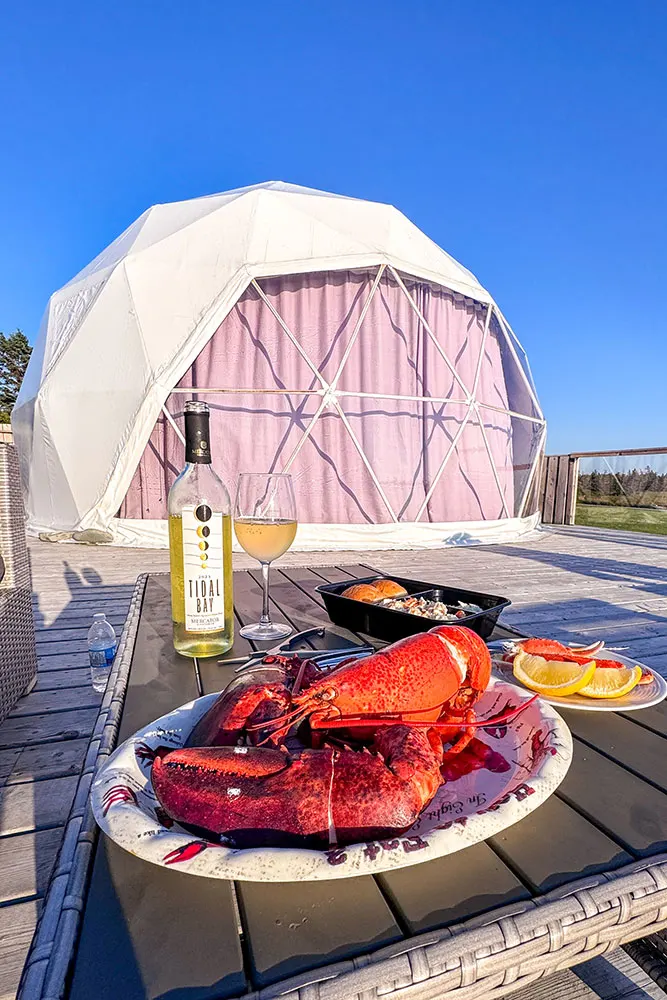
Where to eat whole boiled lobster
You will find whole boiled lobster in plenty of places, especially along the Lobster Trail. But my favourite spot is Hall’s Harbour Lobster Pound (open between May and October).
Sitting right on the Bay of Fundy, famous for having the highest tides in the world, the restaurant serves lobster boiled in seawater, which gives it a subtle brininess you won’t find anywhere else.


Order your lobster, choose your size, and enjoy it with melted butter while watching the tides rise or the sunset. It’s as Nova Scotian as it gets.
Another amazing spot to have whole boiled lobster is at Les Beaux Vendredis Seafood Supper, a really fun community event in Belliveau Cove that takes place every Friday evening in the summer.


I was also very fortunate to be presented with a delicious boiled lobster treat when I stayed at Driftwood by the Bay, one of the most spectacular glamping sites in Nova Scotia.
Lobster roll
Nova Scotia’s lobster roll is famous for one main reason. Aside from the freshness of the lobster meat, locals don’t overcomplicate it.
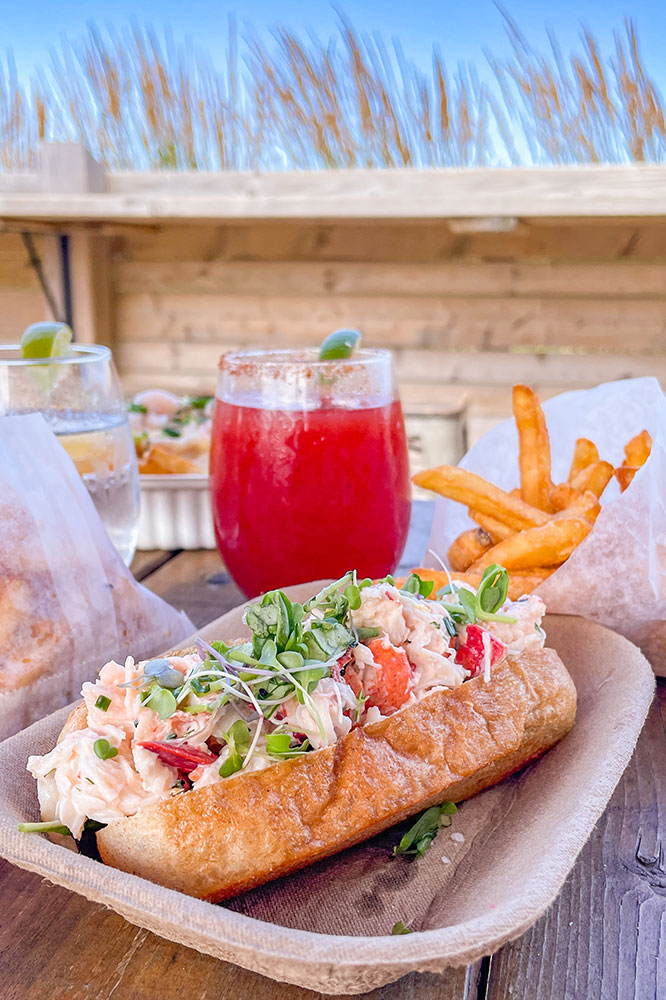

A soft top-split bun, a light touch of mayo or butter, and a generous pile of lobster meat. That’s it. No fillers and no fuss. Just pure, fresh seafood.
Where to eat lobster roll
Lobster rolls are part of everyday coastal life in Nova Scotia. You’ll find them in tiny fishing villages, roadside shacks, cafes, and markets all along the coast.


But the lobster roll at Dennis Point Cafe on the South Shore, is particularly famous.
The lobster roll is everything a good roll should be: generously packed with fresh lobster meat, lightly dressed, and served in a buttery toasted bun. Simple, honest, and delicious.
Add sitting by the water, with the salty breeze and fishing boats in the background, and it makes the whole experience even better.
Creamed lobster
This is probably my favourite way to eat lobster.


Creamed lobster is simple, rich and full of flavour. It was created by Clara Harris, an Acadian Shores restaurant owner, over 50 years ago and it became popular very quickly.
It’s made by gently warming fresh lobster meat in a creamy, buttery sauce, often with just a hint of salt and pepper. Nothing fancy, nothing overdone. The lobster is the star of the show and the cream just brings out its sweetness.
Where to eat creamed lobster
You can find creamed lobster mostly around Yarmouth and the Acadian Shores, usually served over toast.
It’s the kind of dish you might try in a small diner, a coastal café, or even at a community supper.
But if you want to try a more elevated version of it, head to La Cuisine Robicheau along the Baie Sainte-Marie (or St. Mary’s Bay), which specialises in Acadian comfort food.


Hot creamed lobster is one of its specialties, and if you order haddock topped with it there will be no going back. It’s without a doubt the best thing I ate in Nova Scotia.
The flaky haddock was cooked to perfection, and then smothered in a warm creamy lobster sauce that just melted everything in your mouth. Every bite was heavenly.
Lobster poutine
Nova Scotia has taken a Canadian classic, given it a coastal twist, and come up with lobster poutine. It sounds indulgent, and it absolutely is. Crisp fries, fresh cheese curds, and a rich, creamy seafood sauce, all topped with chunks of sweet local lobster.


It’s comfort food with a touch of luxury, but in that very Nova Scotian way where it still feels casual and laid back.
Where to eat lobster poutine
You’ll spot lobster poutine on menus across the province, especially in Halifax and along the South Shore. Some places keep it traditional, others go wild with buttery lobster sauces or extra toppings. But the star is always the lobster.
I’m not usually a fan of poutine, but I’d heard that the lobster poutine at the Argyler Lodge Restaurant was exceptional so I just had to give it a go. And I was really pleasantly surprised by how much I loved it.


Light and crispy fries were topped with fresh creamed lobster that tied everything together. It’s definitely a dish to remember.
Lobster mac and cheese
Lobster mac and cheese is another classic comfort dish that’s been given a coastal upgrade, Nova Scotia style. Cheesy sauce, perfectly cooked pasta, a bit of crunch on top, plus generous pieces of fresh local lobster folded through. What’s not to love?


The sweetness of the lobster cuts through the richness of the cheese, making it feel indulgent without being overly rich.
Where to eat lobster mac and cheese
You can find lobster mac and cheese on menus all over the province. Some places keep it simple, others use locally aged cheeses or bake it until the top is golden and bubbling.
But the best versions always come down to two things: al dente pasta and fresh lobster, caught just offshore.
The lobster mac and cheese at Rudder’s Brew Pub in Yarmouth is everything you want from this classic. It’s made with a creamy cheddar sauce, pasta shells and generous chunks of lobster. All topped with panko breadcrumbs.
The perfect dish when you want something comforting after a day exploring Yarmouth.
Digby scallops
Digby isn’t just known for scallops. It’s the Scallop Capital of the World.


The cold, clean waters of the Bay of Fundy produce scallops that are tender, sweet, and incredibly fresh, known to be some of the best in the world.
So of course, Digby scallops are a must-try in Nova Scotia. When they’re pan-seared properly, golden on the outside and tender in the middle, they melt in your mouth.
Where to eat Digby scallops
You can taste Digby scallops all over the province, but Digby is obviously THE place to go if you want them at their best.
Many local restaurants serve them straight from the day’s catch, often with simple sides that let the scallops shine. They’re fresh, delicate, and absolutely worth planning your route around.


On my first road trip of Nova Scotia, I visited The Crow’s Nest in Digby, where you can try scallops cooked three ways: deep fried, pan fried, wrapped in bacon.
I wanted to try them all, so I ordered the scallops three ways, which included three of each. Each version brings out a different flavour, but the bacon-wrapped scallops were my favourite. The smoky, salty bacon pairs perfectly with the buttery sweetness of the scallops.
Rappie pie
Rappie pie is one of Nova Scotia’s most traditional Acadian dishes and an interesting one.
It’s not actually a pie, but a baked casserole made with grated potatoes that have been pressed to remove the liquid, then mixed with a rich broth and layered with chicken, pork, or sometimes seafood.


The texture is unique: soft and almost creamy on the inside, with a golden, slightly crisp top from baking. Although some people say it’s a bit glue-like. It’s appearance is not the most appetising either, with a greyish colour.
It certainly sounds like an acquired taste. And I say ‘it sounds like’ because on my two visits to Nova Scotia I failed to try it. Whenever I ordered it on several occasions, they’d run out. So it sounds like it’s a popular dish and I’ll just have to go back to see if there’s a third time lucky!
Where to eat rappie pie
You can find rappie pie easily in Acadian communities like the Acadian Shores. Rapure Acadienne is said to be one of the best pies in Nova Scotia, and where a lot of local Acadians buy it to take home. They have outdoor picnic tables you can sit at too.
Seafood chowder
You can’t visit Nova Scotia and not try seafood chowder. It’s one of the most iconic comfort dishes here.


It’s usually packed with a mix of local seafood: haddock, clams, shrimp, scallops, and sometimes chunks of lobster too. The broth is rich and creamy but not heavy, and it carries that fresh, briny flavour of the Atlantic.
Where to eat seafood chowder
You’ll find chowder pretty much everywhere, but each place makes it a little differently. I sampled several along the Chowder Trail, and each one was delicious, but two stood out for me.
Mateus Bistro in Mahone Bay serves a beautiful version filled with haddock, scallops, shrimp, and mussels in a herby creamy broth. It’s hearty but balanced, and perfect after a coastal walk.


Another chowder I absolutely loved was the one served during my visit to the Tusket Islands, with Tusket Island Tours. I went on a day trip when I visited the Acadian Shores and the whole experience stayed with me.
The homemade chowder was rustic, rich, and made with the kind of love that only comes from generations of local family recipes. Eating it outdoors surrounded by sea and wind made it even more special.
Acadian Cajun seafood stew
Acadian Cajun seafood stew is one of those dishes that brings together the history, culture, and flavours of Nova Scotia in a single bowl. It blends Acadian roots with Cajun influence, a reminder of the deep connections between Atlantic Canada and Louisiana.


The stew is rich, warm, and full of personality, usually made with a mix of local seafood like shrimp, scallops, clams, or chunks of white fish simmered in a spiced, flavourful broth.
The seasoning is what sets it apart. It’s bold but balanced, with a little heat, plenty of herbs, and layers of flavour that build as you eat it. Some versions lean more Acadian with a creamier base; others take a Cajun route with tomatoes, peppers, and more spice.
Where to eat Acadian Cajun seafood stew
You’ll find it in Acadian communities and restaurants that celebrate local food traditions.
Saying this, I had it at The Grand Banker Bar & Grill in Lunenburg, not a traditional Acadian town, but where it’s a must-try dish. Hearty, warming and flavourful – just pure comfort food!
Clams
Clams are a big part of Nova Scotia’s coastal food culture, especially along the Northumberland Shore and the Bay of Fundy.


You’ll find them steamed, fried, or folded into chowders, but no matter how they’re prepared, they always taste fresh.
Where to eat clams
Clams are easy to find throughout Nova Scotia. I ate them in a couple of places: The Crow’s Nest in Digby, and at The Wheelhouse Seafood and Pasta Restaurant in Belliveau Cove. Both of them were deep-fried in a light and crispy batter and sprinkled with a bit of lemon. Simple but delicious!
Grosses coques (Atlantic surf clams)
A different kind of clam, grosses coques, also known as Atlantic surf clams or bar clams, can be found mainly along the Acadian Shores. In fact, the Acadian town of Grosses Coques is named after these clams.


These large, meaty Atlantic clams are a real treat. They’re bigger than your usual clams and have a firmer bite, with a clean, briny flavour.
Because of their size, they’re perfect for steaming, chopping into chowders, or serving in hearty dishes where you really want that rich clam taste to come through. You can even eat them raw!
Where to eat grosses coques
You can find grosses coques mainly in areas known for traditional clam digging, like St Mary’s Bay.
Many places prepare the clams in a very simple way – steamed with butter, garlic, and herbs, or served in creamy sauces.
I was lucky to be invited to a local man’s house along St. Mary’s Bay to try them raw straight from the fishing crate and they were just delicious. They couldn’t have been any fresher.
Snow Crab
Snow crab is another seasonal highlight on Nova Scotia’s seafood scene, and it’s just as delicious as the lobster. You just need a bit more patience to eat the legs.


The best way to eat it is simply boiled. The legs crack open easily, revealing long pieces of pure, white crab meat that hardly need anything more than melted butter or a squeeze of lemon.
Where to eat snow crab
If you’re visiting in the summer, head to Les Beaux Vendredis Seafood Suppes in Belliveau Cove on a Friday evening, where locals gather for seafood feasts by the water.


Cracking into fresh snow crab while live music plays in the background is one of the most joyful ways to end the week in Nova Scotia.
Oysters
Nova Scotia is a great place to try oysters, thanks to the clean cold waters of the Atlantic.


They’re the perfect starter on a warm day by the water, and a great way to taste the province’s coastline one oyster at a time.
Where to eat oysters
You’ll find them everywhere from oyster bars in Halifax to tiny coastal shacks and farmers’ markets in smaller towns. Many places serve them straight on the half shell with just a squeeze of lemon or a simple mignonette, letting the natural flavour come through.
For a refined experience, head to Drift in Halifax. Their oyster selection changes depending on what’s freshest that day, but they’re always from the Maritime provinces.
I ordered half a dozen, and they were the plumpest and tastiest oysters I had in a long time, and possibly ever! They were served with lemon, mignonette, a homemade hot sauce and horseradish. Just delicious!
Donair
Donair is pure comfort food. It’s messy, saucy, and completely irresistible. It’s considered Halifax’s official dish, and once you try one, you’ll understand why locals are so loyal to it.
Unlike a Greek gyro, the donair uses spiced ground beef cooked on a vertical rotisserie, sliced thin, and wrapped in warm pita. But the real star is the famous donair sauce: sweet, garlicky, and totally unique to Nova Scotia.


You’ll find donairs everywhere, from late-night takeaways to old-school diners and neighbourhood pizza shops. They’re especially popular after a night out in Halifax, but they taste just as good in the middle of the day — as long as you’re prepared to get a little messy.
It’s quirky, nostalgic, and very local. If you want to experience Nova Scotia the way locals do, trying a donair is essential. It’s the province’s most beloved guilty pleasure.
Wild blueberries
You’ll find wild blueberries everywhere in Nova Scotia, in pies, jams, muffins, smoothies, and even sprinkled over breakfast bowls.


Wild blueberries are smaller and darker than the cultivated kind, and they pack a lot more flavour.
Where to eat wild blueberries
You’ll see signs for fresh blueberries all summer, especially in rural areas where small farms and roadside stands sell them by the pint.


Although Oxford is the Wild Blueberry Capital of Canada, you can find wild blueberries throughout the province from late July to the end of August/early September.
I went blueberry picking at Elderkin’s Farm in Wolfville and it was really fun! Nothing like a pun of freshly picked berries.
Molasses cookies are one of the most beloved Nova Scotia treats.


They’re soft, chewy, and full of warm spices, with that deep, rich sweetness you only get from molasses.
Where to eat molasses cookies
You’ll find molasses cookies in most bakeries and cafes, each with their own version. Some are extra soft, almost cake-like, while others have a gentle crisp around the edges.
I tried SIP Cafe’s cookies in Yarmouth. I bought some to take with me when I went to Cape Forchu Lighthouse and they were the perfect snack for a little day trip.
Must try drinks in Nova Scotia, Canada
Rum from Ironworks Distillery
Lunenburg was a major hub for rum running during the US Prohibition period (1920s-30s), and Ironworks Distillery has put modern Nova Scotian rum on the map.


Housed in a former marine blacksmith’s shop on the harbour, the distillery produces small-batch rum using traditional methods.
Made with molasses and aged right on the coast, their rum is smooth, rich, and naturally sweet, with a unique touch from the salty air.
Visiting the distillery is half the experience. There’s a tasting room where you can taste the spirits, learn about the process, and see the aging barrels stacked in the old building.


They produce several styles, but the favourites tend to be their amber and spiced rums. My personal favourite was the maple rum, so I took a bottle home with me. Aside from being delicious, I don’t think you can get more Canadian than that.
Tidal Bay wine
Tidal Bay is Nova Scotia’s signature wine and the first officially certified appellation in the province. It’s crisp, bright, and aromatic, with a refreshing acidity that goes perfectly with seafood.


Tidal Bay is produced by several local wineries, but every bottle must follow strict guidelines to reflect Nova Scotia’s cool climate style. Each winery gives it its own personality, but they all share that unmistakable freshness.
Where to try Tidal Bay wine
You’ll find Tidal Bay on almost every restaurant menu and tasting bar across Nova Scotia, especially in the Annapolis Valley and the Gaspereau region.
I tried several brands of Tidal Bay throughout my trips, but I would highly recommend visiting one of the vineyards in the Wolfville area.


I visited the Domaine de Grand Pre Winery for a wine tasting, where aside from Tidal Bay, I also tried other Nova Scotian wines like L’Acadie, another refreshing local white grape.
But if you only try one Nova Scotian wine, make it a Tidal Bay.
FAQs about food in Nova Scotia
Nova Scotia is best known for its seafood, especially lobster, scallops, chowder and haddock. The province is also famous for donair (the official food of Halifax), wild blueberries, and traditional Acadian dishes like rappie pie.


Travellers often search for the best spots along the Lobster Trail, with favourites including Hall’s Harbour, Baddeck Lobster Suppers, and local seafood shacks along the South Shore and Bay of Fundy. Whole boiled lobster and lobster rolls are must-tries.
Wild blueberry pie is the most iconic dessert, thanks to the province being a major producer of wild blueberries. Molasses cookies are other traditional favourites you’ll see in bakeries and cafes across the province.


There are many, and travellers search for them a lot. Rappie pie and seafood chowders with Acadian influences are common in regions like Clare and Argyle. These dishes connect directly with the province’s Acadian heritage.
Have you tried any of these foods in Nova Scotia?
Let me know in the comments below!
Like this post? Pin and save for later


Disclosure: This post has been created as a partnership with Nova Scotia Tourism. As always, all views are my own.