
A guide to visiting Phuket Elephant Sanctuary, the most ethical elephant sanctuary in Phuket, Thailand. It includes details about what to expect, how to get there, and why you should only consider visiting an ethical sanctuary and avoid elephant camps.
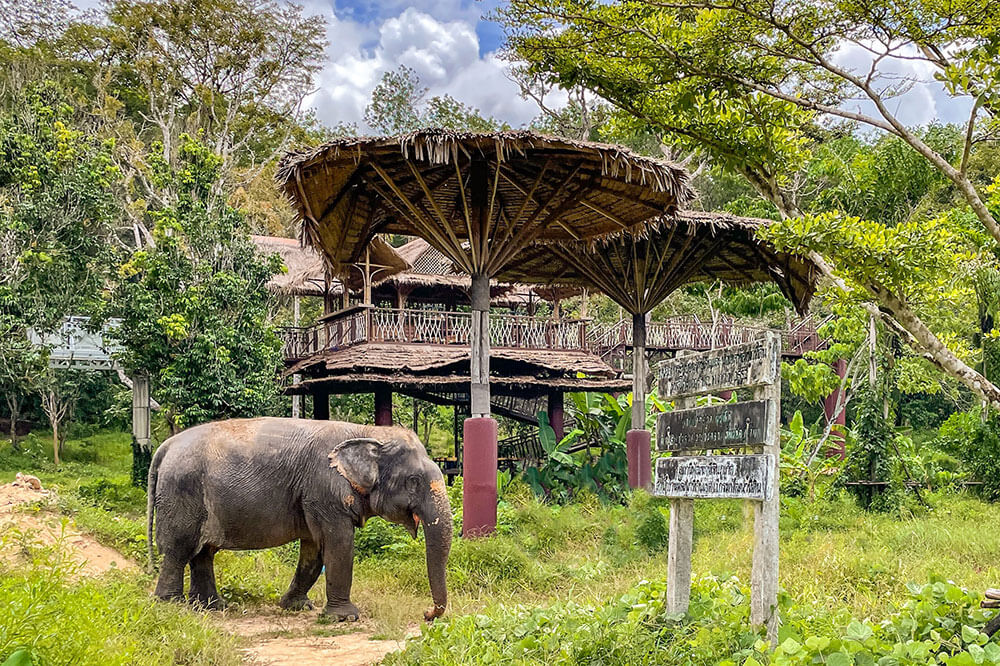

One of the things that are a must when in Phuket, is visiting an ethical elephant sanctuary. Getting (relatively) up close and personal with these magnificent animals will be a highlight of your Phuket itinerary.


This is a fantastic opportunity to learn about elephant behaviour, the role of elephants in Thai culture, and also to get to know each of the elephants’ personal stories and how they ended up in the sanctuary.
It will both break your heart and will make you fall in love with them even more.
But before you decide which sanctuary to visit, there are a few things to take into consideration.
Not all elephant ‘sanctuaries’ in Phuket are ethical
The best way to see elephants in Thailand, is of course in the wild, particularly in Khao Yai National Park. But when seeing them in the wild is not possible, the best alternative is to visit an ethical elephant sanctuary.
I visited Phuket Elephant Sanctuary (PES) and I was really impressed by the work they are doing rescuing and looking after their elephants. But I have to admit that I was a little bit nervous about visiting beforehand.


Phuket has a number of elephant sanctuaries that, sadly, are not true sanctuaries, but rather they use elephants as a tourist attraction, and I worried that PES may be one of them.
The interest of these faux-sanctuaries does not lie with the welfare of the elephants, so it is very important to choose a truly ethical sanctuary.
I would urge you to avoid pseudo-sanctuaries, as well as other visitor attractions that use elephants (or any other animals) for human entertainment, and choose to visit an ethical sanctuary like PES that has the interests of the elephants at its heart.


To make things a bit harder, Phuket has a lot of elephant camps with similar names. So make sure that you choose the true Phuket Elephant Sanctuary, rather than one with a slight name variation.
Is Phuket Elephant Sanctuary ethical?
One key thing to remember when trying to identify whether an elephant sanctuary in Phuket (or anywhere else) is ethical, is that a true sanctuary never buys, sells, trades, exploits or profits from elephants. But this is not always so obvious.


One thing to do is to check what their policy is on animal interaction. If you get to interact closely with the elephants, whether it’s by bathing them, swimming with them, and particularly by riding them, it is NOT an ethical sanctuary, but rather an elephant camp.
I realise that a lot of people have riding or bathing with elephants on their bucket list, but this is very harmful to the elephants, and sometimes people do this due to lack of awareness of the impact this has on the animal’s wellbeing.
Bathing is often seen as harmless for the elephants, however, this is extremely stressful for them, and it prevents them from enjoying their bath and behaving naturally.
Another thing to look out for is whether the mahouts (the elephant keepers) use bullhooks, punish the elephants in any way, or whether they force the elephants to do something they do not want to do.


Also, a true ethical elephant sanctuary should have a large natural environment that allows elephants to roam freely and behave as naturally as possible.
How Phuket Ethical Sanctuary started
Phuket Elephant Sanctuary is the first and most ethical elephant sanctuary in Phuket. With 12 elephants in its care, PES focuses on rescuing older elephants that can no longer work in the logging industry and whose owners no longer have a function for them.
Montri Todtane, the founder of PES, is a former owner of an elephant riding camp, who realised that the elephants were working too hard.


Montri heard about Chiang Mai’s Elephant Nature Park (ENP), one of the most ethical animal sanctuaries in the world according to National Geographic, alongside Libearty Bear Sanctuary in Romania.
He travelled to Chiang Mai to learn more about it, and was inspired to start his own ethical sanctuary, opening PES in partnership with Sangduen Lek Chailert, the founder of ENP.
Why choose Phuket Elephant Sanctuary
Phuket Elephant Sanctuary has 12 mostly female elephants that roam freely around their 30-acre retirement home next to the Khao Phra Thaeo National Park, where they are looked after in the last years of their lives.


You can observe the elephants at a safe distance from the new 600-metre long canopy walkway built to provide the elephants with maximum freedom to roam and socialise among themselves without the interference of visitors.
PES carries out two daily guided tours, one in the morning and one in the afternoon.
The tours start with a heartbreaking video (bring tissues!) where you learn about the cruel process of domesticating an elephant, known as ‘crushing’. You then go on to observe the rescued elephants safely in their natural habitat.
Each elephant has a dedicated mahout that accompanies them for safety. As you walk around you will see them eating fruit from the many fruit trees around the sanctuary, ripping young banana trees planted especially for them, and bathing in a pond fed by waters from the national park waterfall.


One of the things that I was really happy to see is that there is no bathing or any sort of interaction between visitor and elephant, allowing the animals to be themselves and behave as naturally as they would in the wild.
There are, however, a handful of elephants at PES that are comfortable around humans, so it is possible to get close to them at a feeding station, where you can hand out pieces of fruit to those elephants who would like some.
The most important aspect is that they approach the feeding station voluntarily.
Book half a day in Phuket Elephant Sanctuary here
How you can support Phuket Elephant Sanctuary
Looking after 12 elephants with their medical care, maintenance, and feeding needs is very expensive.
Here are a few innovative ways we can all help support PES.
Visit Phuket Elephant Sanctuary
Ok, this one is not so innovative, but if you are looking to visit an ethical elephant sanctuary in Phuket, visiting Phuket Elephant Sanctuary is the best way to support them.


Your entrance ticket contribution will go towards creating and maintaining this natural home for the elephants, as well as feeding them and keeping them healthy.
Buy a Happy Meal
Each elephant needs 300 kilos of foraging plants every day. But in addition to this, Phuket Elephant Sanctuary makes soft rice balls to supplement their diet.
The rice balls are made of steamed rice, sweet potato, carrots and squash, and all elephants love them. They are particularly good for older elephants who have worn off their teeth.


The cost of one of these Happy Meal rice balls is 30USD per day for all the elephants, which is not much, but it can quickly add up.
Support their food source self-sufficiency project
So recently Phuket Elephant Sanctuary has changed its approach to food, and has taken steps to become more self-sufficient by planting 1,200 banana trees, fishtail palms, sugar cane, and napier grass all over the sanctuary.


There are also lots of fruit trees around that the elephants can help themselves to. Elephants love these plants and fruits, so they eat them directly from the grounds as they roam around.
You can support this self-sufficiency project by buying Napier Grass cuttings at 1 USD each. And you’ll get a short video of your grass being planted in return! Just add the note “Napier Grass” on your donation.
Buy a Napier Grass cutting here
Here you can find more ways to support Phuket Elephant Sanctuary.
Practical tips for visiting Phuket Elephant Sanctuary
How to get there
You can book Phuket Elephant Santuary’s transportation for convenience. Depending on where you are staying in Phuket, it’ll cost an additional 800-2,000 THB.


Alternatively, arrange a taxi through your hotel. Just ensure they take you to the right sanctuary, as there are a few elephant camps that have very similar names to Phuket Elephant Sanctuary.
Ticket prices
A half-day ticket costs 3,000 THB (~ £68 / 95 USD). The ticket includes a delicious Thai lunch, and you will be provided with mosquito spray, wellies and socks if it’s muddy and wet, umbrellas for the rain or the sun, and rain coats.


The ticket doesn’t include elephant rides, shows, bathing, trunk hugging, elephant kisses, sitting on or lying on the elephants, as this is not available at Phuket Elephant Sanctuary.
Book half a day in Phuket Elephant Sanctuary here
Tour and opening times
Tours are conducted in the morning at 9.30am and in the afternoon at 1.30pm. Please ensure that you arrive around 15-20 mins before the start time.
Phuket Elephant Sanctuary is open every day of the year except for 13th April (Songkran Day).


FAQs about visiting an elephant sanctuary in Phuket, Thailand
Yes, it is. Phuket Elephant Sanctuary is the first ethical elephant sanctuary in Phuket and it is endorsed by National Geographic and World Animal Protection. PES’ first priority is the welfare of the elephants and it does not offer elephant rides, shows, bathing, trunk hugging, elephant kisses, sitting on or lying on the elephants.
A half-day ticket costs 3,000 THB (~ £68 / 95 USD). The ticket includes a delicious Thai lunch, and you will be provided with mosquito spray, wellies and socks if it’s muddy and wet, umbrellas for the rain or the sun, and rain coats. You can also book a hotel transfer for convenience which, depending on where you are staying in Phuket, it’ll cost an additional 800-2,000 THB.
Do you know of another ethical elephant sanctuary in Phuket?
Let me know in the comments!
LIKE THIS POST? PIN AND SAVE FOR LATER


Disclosure: This post has been created as a partnership with the Tourism Authority of Thailand (TAT). As always, all views are my own.
Laura
Tuesday 10th of December 2024
Thank you for highlighting a true sanctuary that does not allow riding/bathing/breeding.