Morocco’s medinas are a masterclass in sensory overload, where the art of the deal is as old as the city walls themselves. But hidden among the chaos are nine souvenirs so distinctive, so deeply tied to this ancient culture, that they’ll stop every guest in your home dead in their tracks.

Shopping in Morocco is a must for any visitor to this fascinating country – the browsing, the negotiating, and the feeling that you’ve come away with a bargain are all part of the experience.
It’s also a great way to contribute to the local economy by supporting local businesses and producers, so don’t be shy – put your haggling hat on and bag yourself some awesome Morocco souvenirs!
In this guide:
- Discover 9 authentic Moroccan souvenirs that actually make meaningful gifts instead of generic tourist trinkets
- Get tips on how to care for and display popular Moroccan buys like carpets, ceramics, and spices once you’re back home
- Learn which items offer the best value and where to find them in the souks without overpaying or ending up with a fake
What to Buy in Morocco?
Morocco’s souks are stuffed with things you’ll want to bring home, but a handful of items stand out as the most authentic, best-value, and easiest to actually enjoy once you’re back – think lanterns, leather, argan oil, carpets, and rose water, to name a few. Below, I’ve pulled together 9 of the best Morocco souvenirs, most contributed by fellow travel bloggers who’ve bought (and bargained for) these pieces themselves. But first, a bit of groundwork so you know how to shop like a local.
Morocco Souvenirs: What You Need to Know
There are a couple of things you need to know before you venture shopping in Morocco in order to come away with a bargain.

Where to shop
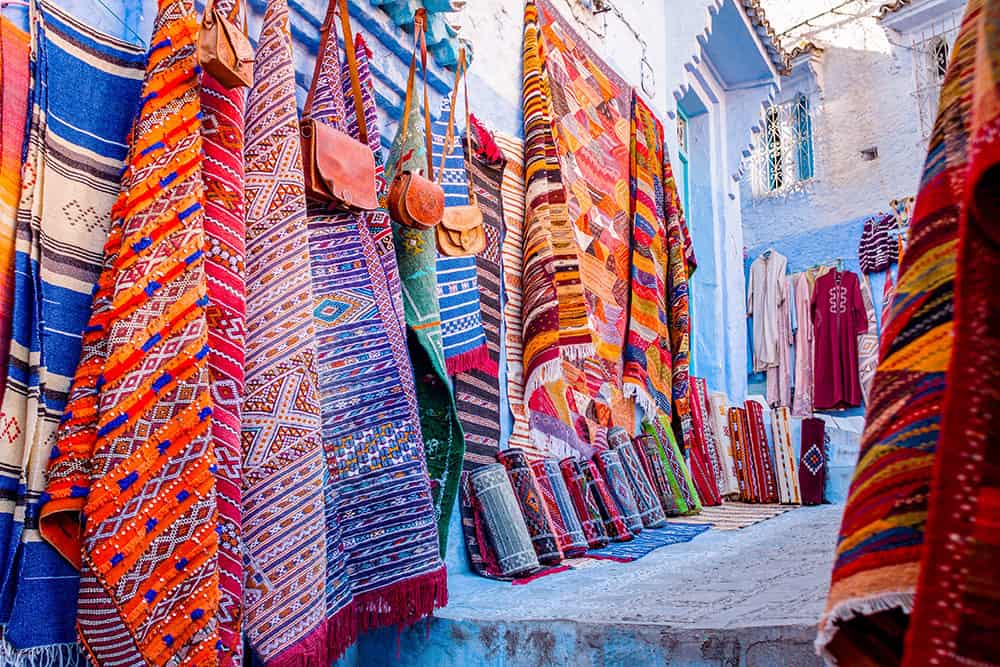
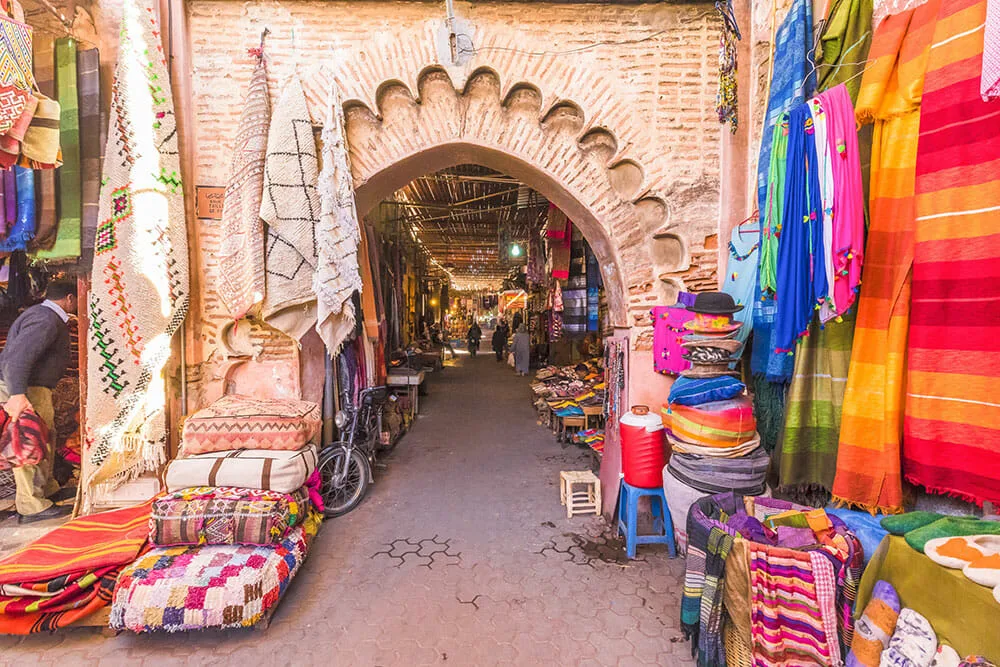
The vast majority of the shopping in Morocco happens in the souks or markets. These are normally located within the old city walls, or medina.
Money
Cash is king. Only a few vendors accept credit cards, so make sure you have enough cash with you. The local currency is the Moroccan Dirham (Dhs), and at the time of writing 10 Dhs are approximately $1 USD. Prices below are given in both Dhs and USD.
Prices and negotiating
There is a chance that you won’t know whether a price is fair or overinflated, so here are a couple of tips to set you on the right foot.
Scout several shops beforehand to get a feel for what sort of prices vendors are quoting. Bear in mind that shops closer to main squares and tourist attractions will quote higher prices, so try and find shops in side alleys that get less tourist traffic for a better chance of a bargain.
Haggling or negotiating is part of the process of shopping in Morocco. The prices first quoted by vendors are deliberately inflated, so you will be expected to haggle for a reduction.
I personally love haggling, but I realise that it doesn’t come naturally to everyone. I always recommend offering back half of the money quoted. I know it sounds harsh, but don’t worry, you will eventually raise your offer as the vendor lowers the original price.
A good tactic is to walk away, or pretend to walk away, and they will most likely call you back to continue the negotiation. Have a number in mind of the maximum amount you’d like to spend and have fun trying to stay below that number.

Most vendors have a great sense of humour and like to have fun in the haggling process. Some may even invite you to sit down for a cup of tea. If you are serious about buying, go ahead and accept the invitation. But if you are only browsing, feel free to reject it and don’t waste vendors’ time.
You may also come across vendors who pretend to be offended by your counteroffer. Don’t be scared to walk away and move on to another shop.
Finally, note that some shops will have signs that read “Fixed Price.” If you see this sign, don’t try to negotiate, to avoid causing offence.
9 Unique Morocco Souvenirs: What to Buy in Morocco
Here’s what actually makes each of these souvenirs worth your suitcase space – what they’re good for, why they’re better than a generic trinket, and roughly what you should expect to pay.
1. Basket and Straw Bags

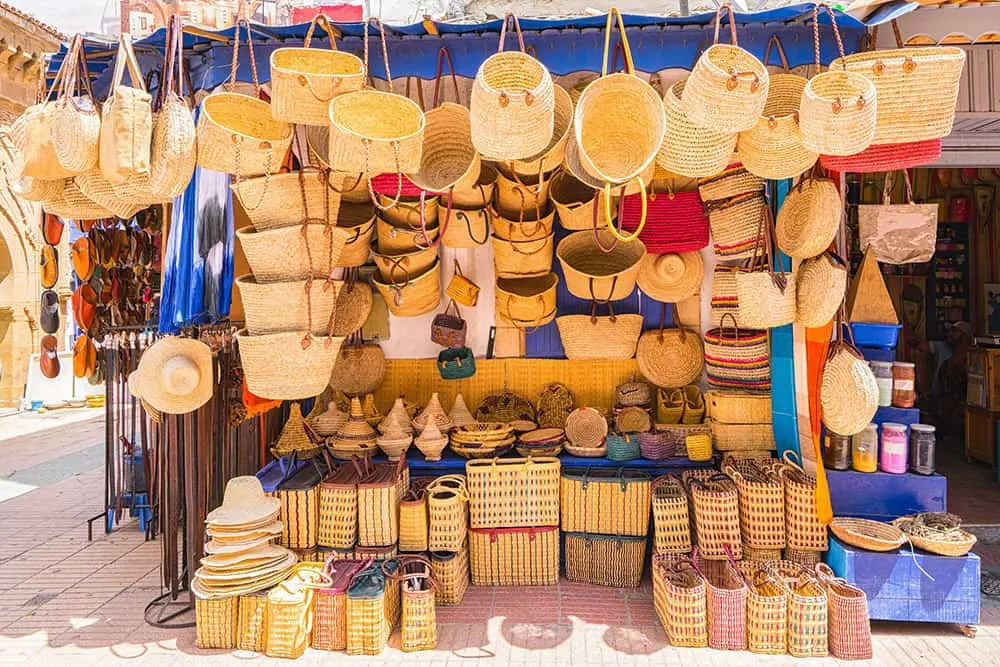
Boho style is the trend at the moment, and Morocco is the perfect place to pick up those super cute basket or straw bags you see all over Instagram and in magazines. There are so many designs that you will actually have trouble choosing the right one, so there’s a real risk you’ll end up with several bags.
You’ll find bags of all shapes and sizes, in colourful and neutral designs. Some can even be personalised with embroidery, pompoms, or tassels.
Why it’s worth buying: it’s practical (you’ll actually use it as an everyday bag), lightweight to pack, and doesn’t look like it came from an airport gift shop.
The selection seems limitless. If you find yourself in Marrakech, head to the souk near the Cafe de Epices, where you can get a large bag for about 100 Dhs (~$10 USD). You can also find baskets for the home here, useful as decoration, laundry baskets, or storage accessories.
Buy Moroccan Basket and Straw Bags on Etsy
2. Lanterns


There are so many incredible things to buy in Morocco that you can easily spend days wandering the souks of Marrakech, Fes, and Meknes.
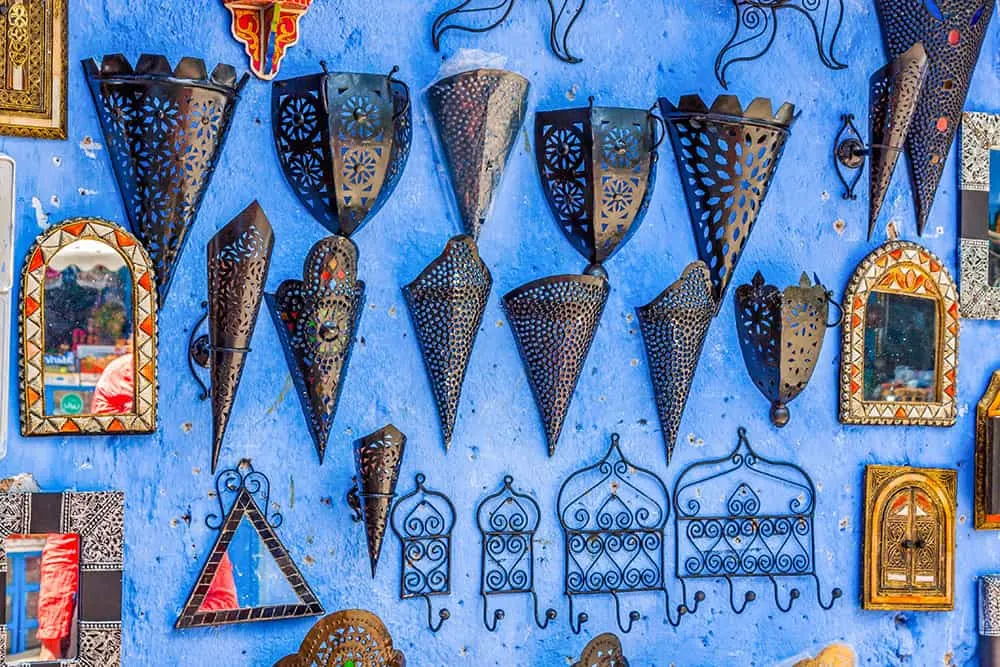
One of my absolute favourite things, however, is the lanterns. Many are embossed with hundreds of tiny holes, making a spectacular glow in the dark.
The owners of the tiny shops that specialise in them will plug a light in so you can see the effect of the light gleaming through the holes. They come in all shapes and sizes; some hang, others are freestanding.
I totally fell in love with a metal and glass standing lamp, and after some bargaining, it now sits on a side table in my living room.
How to care for it: once home, dust lanterns gently with a soft cloth and avoid harsh cleaning products on painted or coloured glass – it can strip the colour. If it’s metal, a little furniture wax will keep it from tarnishing.
Quality varies, and if you look closely, you can see the difference between something simple made from thin material that bends easily, and better-quality lanterns with superior materials and more intricate, adept artisanship. Obviously, this affects the price. I got my small lamp for about 200 Dhs (~$20 USD) in the souks in Meknes, but they’re common in Marrakech and Fes too.
By James Ian from Travel Collecting
3. Argan Oil


During my one week trip around Morocco, I saw a number of products that were constantly at the centre of markets and bazaars. One such product was argan oil.
Native to Southwestern Morocco, the Argania plant has become a huge economic sector for the country. Extracting argan oil is quite labour intensive – after the fruit ripens, the pulp has to be removed and the seeds taken out to be roasted.
Argan oil can be found throughout the many streets and medinas in Marrakech. Not only is it a great condiment for bread and pasta, it also does wonders when added to your hair and skin-care routine.
Traditionally, argan oil was extracted by hand, which made it difficult to produce in large quantities. In the early 2000s, a number of foreign investors built cold-pressing plants that took much of the profit away from Berber communities who relied on this source of income.
Luckily, recent years have seen NGO and governmental efforts to establish argan oil cooperatives. These co-ops give local women access to machinery and equipment that can compete with foreign products – an important step in bringing profit back into the community.
How to spot a fake: real argan oil should smell nutty (not overly floral or perfume-like), have a golden-amber colour, and shouldn’t feel greasy going in – check the colour, texture, and smell before purchasing. As with most commodities, quality determines price, and a bottle of high-quality oil can cost upwards of 200 Dhs (~$20).
Buy Moroccan Argan Oil on Etsy
By Daisy Li from Beyond My Border
4. Leather Poufs


Leather poufs are a popular souvenir to buy in Morocco, as they’re very easy to bring home. You’ll see them displayed fully stuffed so you can see what they look like, but you’ll actually be buying them unstuffed, which makes them much easier to carry.
They’re very popular home accessories, and you’ll find them back home in boho-style boutique shops – for many times the price you’d pay in Morocco.
Use case: extra seating, a footrest, or a stylish accent in a living room – and because they pack flat, they’re one of the easiest big-ticket souvenirs to actually get home in your luggage.
A leather pouf will cost between 150 Dhs and 300 Dhs (~$15–$30 USD), depending on size and quality.
Buy Moroccan Leather Poufs on Etsy
5. Leather Clothing


Leather clothes are everywhere in Morocco: gorgeous biker jackets in vibrant shades of blue and pink, edgy bomber jackets with studs and zips, slippers and shoes with straps and tassels, skirts, trousers, and belts galore.
You’ll see leather clothes on display everywhere you go – in the medina in Marrakech there’s an entire street devoted to shoes! But without question, the best place to buy leather clothes is directly from the Chaouwara tannery inside Fes medina.
Here, dozens of leather shops surround an open courtyard in which skins are cured and dyed using ancient methods. You’ll need to pass through one of the shops to see it (and hold your nose – it stinks!) but it’s truly a sight to behold and well worth a visit.
If you’re not buying, you may need to pay a small fee, but once you’re inside, you’ll probably find the displays of stunning coats and jackets too much to resist. There are designs and colours you’ll simply never find on the high street, and if you haggle hard, you’ll get them for half the price.
Real value comparison: when I visited Morocco earlier this year, I bought a stunning buttery-soft bomber jacket that would have easily cost £300–400 (~$400–$530) in London, for just £150 (2,000 Dhs/~$200).
By Bella from Passports & Pixels
6. Tea


Mint tea is a way of life in Morocco. In every meal, and in between snacks and beverages, there’s tea. Served in a beautiful teapot, usually made of metal, its exquisite shape resembles that of a genie lamp.
Tea is shared between family and friends for all occasions, and just sitting with people over tea is a way of life in itself. During our time in Marrakech, Morocco with our kids, we enjoyed tea multiple times a day with the locals.
Teashops that sell loose leaves can be found in various shops across Morocco’s major cities. While exploring Marrakech, we saw that teashops tend to be filled floor to ceiling with loose-leaf tea, oils, and spices.
Green tea, as well as Maghrebi mint tea, are popular types and served with most meals and snacks. Tea is usually served very sweet, with the sweetness level depending on the region – it’s best to ask in advance for tea without sugar if you’d prefer it that way.
Use case: loose-leaf tea is affordable, packs light, and doubles as a genuinely lovely gift – it’s widely considered a staple of Moroccan culture, so it makes a thoughtful, low-cost souvenir for a big group of people back home.
By Diana from The Elusive Family
7. Berber Carpets


Berber carpets are the classic souvenir from any country in North Africa and the Sahara. We went hunting for a carpet in Morocco and found a very unique piece of art.
Usually, Berber carpets come in traditional and modern designs, distinguished by their knotting patterns, dyes, and fabric textures. The history of these carpets goes back several millennia – tribes once created their own carpets and used the patterns as a sign of their tribe.
Most people who come to Morocco looking for their own Berber carpet are usually shocked at the prices, even for the smaller pieces. But an original Berber carpet is made by hand and, thus, needs a little investment. We got ours through a shop seller in the souk of Marrakech, who told us to come to his home village somewhere in the mountains – and so we did. We ended up in a true carpet village, where we found our carpet made by a rather old woman who had been doing this for years and years.
How to care for it: vacuum gently (avoid a beater bar on delicate weaves), rotate it occasionally so it wears evenly, and keep it out of direct sunlight if you want the colours to stay vibrant. If you’re shipping one home, ask the vendor about rolling (not folding) it for transport.
As a tip for carpet hunters: don’t take the very first one – stroll around the market. It’s also helpful to get along well with vendors, who might bring you to the origin of their goods, which doesn’t only make for a good story but also a better price.
Buy Moroccan Berber Carpets on Etsy
By Clemens from Travellers Archive
READ MORE
Visiting a Berber Hospitality Centre in the Atlas Mountains
8. Blankets from Chefchaouen


I am not a person who buys a lot of souvenirs, and most of the time I walk right past all the vendors selling magnets, key chains, and t-shirts. Chefchaouen caught my attention, though, with its colourful woollen blankets that I hadn’t seen anywhere else in Morocco.
Chefchaouen is famous for its hand-woven wool items, dyed in bright colours. The deep blue blankets were my favourite, and you’ll see them used for decoration in many hotels and restaurants. Needless to say, I loved them so much I bought one.
Almost all souvenir shops sell the blankets, although the quality varies and I doubt they’re all handmade. Regardless, Chefchaouen blankets make a great souvenir, and mine has its proud place at home on my sofa. If blankets aren’t your thing, they also sell shawls and lanterns made from the same material, which make great gifts for yourself or people back home.
By Ellis from Backpack Adventures
9. Thuya Wood Boxes from Essaouira

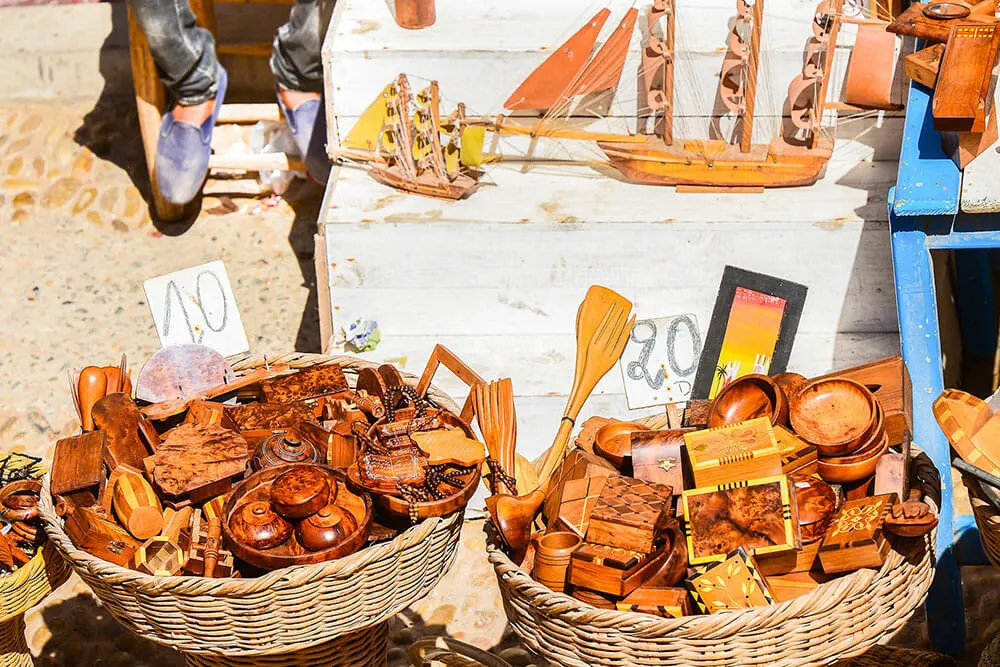
Morocco is the perfect place to buy souvenirs, and each city specialises in different crafts. In Essaouira, the most popular souvenirs are wooden jewellery boxes made out of polished Thuya wood, often inlaid with bone, mother of pearl, aluminium wire, or other woods.
Thuya is a shrub indigenous to Morocco – it grows around Essaouira, hence the local craft. You can buy beautifully made boxes in every second souvenir shop in the medina. Their price and quality of finish vary: the cheapest may be as little as 10 Dhs ($1), more carefully crafted ones cost 70–80 Dhs (~$7–$8), and above that, you can pay whatever you can afford.
Use case: the most interesting are the “magic boxes,” which don’t appear to have any way to open them until you know the secret. There are many designs – perhaps you have to slide out a hidden slip of wood, or with others it’s just the way you hold it before pulling the whole thing apart. With a third type, there’s a metal key, but the key itself is hidden in a secret compartment. For our girls and us, going stall to stall trying to open different magic boxes was one of the happiest things to do in Essaouira.
Buy Moroccan Thuya Wood Boxes on Etsy
By Ania from The Travelling Twins
Bonus: Rose Water and Rose Oil


Fragrant festivals welcome spring in the Dades Valley of Morocco. This region is known for its flowers, particularly its roses. Products like rose water and rose oil are perfect souvenirs that you’ll enjoy long after your vacation.
The cost of rose oil varies drastically depending on what you’re looking for. A high price doesn’t always mean higher quality, although purer rose oil can genuinely be expensive – a large number of flowers are used for a small amount of oil; 10,000 roses make just 5ml of pure oil! Asking whether the oil is extracted or distilled will give you an idea of the price you should pay. Distilled is usually more expensive, but extracted oil can often have a stronger scent, so personal preference plays a part.
How to display and use it: keep rose water and rose oil out of direct sunlight to preserve the scent, and use small glass bottles if decanting for gifts. Beyond a Valentine’s Day bouquet substitute, rose oil is wonderful for skin, and can be used as both a perfume and for aromatherapy. Visit Morocco in May, and you can plan a trip to the Valley of Roses Festival in this section of the Atlas Mountains.
Buy Moroccan Rose Water on Etsy
By Abbie Synan from Speck on the Globe
Common Mistakes to Avoid When Buying Souvenirs in Morocco
After years of shopping in Moroccan souks (and a few lessons learned the hard way), here are the mistakes I see travellers make most often:
- Buying the first thing you see. Prices are almost always inflated for the first shop you walk into near a tourist hotspot. Scout a few shops before committing.
- Accepting the opening price. Haggling isn’t rude in Morocco – it’s expected. Not negotiating means you’re likely paying double, or more.
- Skipping the smell/texture test on argan oil and rose products. Genuine oils have a distinct look and smell; if it seems off, it probably is.
- Assuming a carpet is handmade because it’s called “Berber.” Ask questions about where and how it was made – a good vendor will happily tell you the story.
- Trying to haggle at a Fixed Price shop. These are usually government-regulated cooperatives (common with argan oil and carpets), and attempting to negotiate can cause offence.
- Forgetting about cash. Most souk vendors don’t take cards, so carry enough dirhams before you head out shopping.
- Not checking baggage allowances before buying bulky items. Carpets, lanterns, and poufs are heavier and bulkier than they look in the shop – some vendors can arrange shipping, so ask before you buy if you’re tight on luggage space.
Tips for Things to Buy in Morocco
- Set a maximum price in your head before you start haggling, and don’t be afraid to walk away – vendors will very often call you back with a better offer.
- Offer around half the quoted price as your opening counteroffer, then work your way up gradually.
- Shop away from the main squares. Side-alley shops with less tourist traffic tend to quote fairer starting prices.
- Accept the tea if you’re serious about buying. It’s part of the process, and a great way to build rapport with a vendor.
- Buy directly from source where you can – like the Chaouwara tannery in Fes for leather, or a carpet village outside Marrakech – for better prices and a better story.
- If you run out of time (or suitcase space), most of these souvenirs are also available online, so you don’t have to leave anything behind.
Morocco Souvenirs Online
If you have forgotten to buy something in Morocco, there are a few options on Etsy, so you can have them shipped directly to your home. Here are a few examples:
- Lanterns
- Basket and Straw Bags
- Argan Oil
- Leather Pouffes
- Moroccan Mint Tea
- Berber Carpets
- Thuya Wood Boxes
- Moroccan Rose Water
Frequently Asked Questions
It really depends on what you want out of it. For something practical and affordable, mint tea or rose water are hard to beat. For a real statement piece, a hand-knotted Berber carpet or a leather jacket from the Fes tannery will stay with you for years.
Prices vary hugely depending on size, materials, and how much haggling you do, but expect handmade Berber carpets to require a genuine investment – they’re labour-intensive and made by hand, so don’t expect them to be cheap, even after negotiating.
No – haggling is a normal, expected part of shopping in Morocco, and most vendors enjoy the back-and-forth. The exception is shops marked “Fixed Price,” where you shouldn’t try to negotiate.
Check the colour, texture, and smell before buying. Genuine argan oil has a nutty aroma and golden colour; ask whether rose oil is extracted or distilled, as this affects both scent strength and price.
Yes – many souk vendors can arrange shipping for bulkier items like carpets, and if you don’t manage to buy everything in person, versions of most of these souvenirs (lanterns, leather poufs, tea, rose water, and more) are also available on Etsy.
Be cautious with anything sold as “authentic” for a suspiciously low price, particularly carpets and leather goods, as mass-produced imitations do exist. Buying from source (tanneries, cooperatives, or artisan villages) is the safest way to avoid fakes.
Have you ever done any shopping in Morocco? What Morocco souvenirs did you buy?
Let me know in the comments!
Like this post? Pin and save for later


